Visit Mazar-i-Sharif
Afghanistan's spiritual heart. Blue tiles, ancient ruins, and the warmest hospitality in the north.
📍 Province: Balkh
🏔️ Altitude: 357m
👥 Population: ~500,000
Afghanistan's spiritual heart. Blue tiles, ancient ruins, and the warmest hospitality in the north.
In short (TL;DR)
Mazar-i-Sharif is the capital of northern Afghanistan and home to the dazzling Blue Mosque (Shrine of Hazrat Ali). Set on the Balkh plain at just 357 metres, it pairs naturally with the ancient ruins of Balkh, 20 km west. The best time to visit is spring — especially Nowruz in March — and autumn. Go Kabul runs guided northern-Afghanistan tours with flights and vetted stays.
Mazar-i-Sharif at a glance — Quick Facts
Last updated: July 2026
Mazar-i-Sharif is Afghanistan's fourth-largest city and the undisputed capital of the country's northern region. Situated in the fertile plains of Balkh Province, just 55 kilometres from the Uzbekistan border, Mazar has served for centuries as a crossroads of trade, faith, and empire. The city's name translates to "Noble Shrine," a reference to the magnificent Blue Mosque at its centre, believed by many to hold the tomb of Ali ibn Abi Talib, the cousin and son-in-law of Prophet Muhammad.
Unlike the rugged mountain terrain that defines much of Afghanistan, Mazar sits on a broad plain at just 357 metres above sea level. The landscape is flat and expansive, with fields of wheat and cotton stretching toward distant ridgelines. In spring, the surrounding countryside erupts into colour, and the city itself becomes the epicentre of Afghanistan's most joyous celebration: Nowruz, the Persian New Year.
For travellers, Mazar-i-Sharif offers something rare in Afghanistan: a relatively relaxed atmosphere, well-maintained infrastructure, and a concentration of historical and spiritual landmarks within easy reach. Whether you come for the Blue Mosque, the ruins of ancient Balkh, the carpet bazaars, or the sheer warmth of northern Afghan hospitality, Mazar delivers an experience unlike anywhere else in the country.
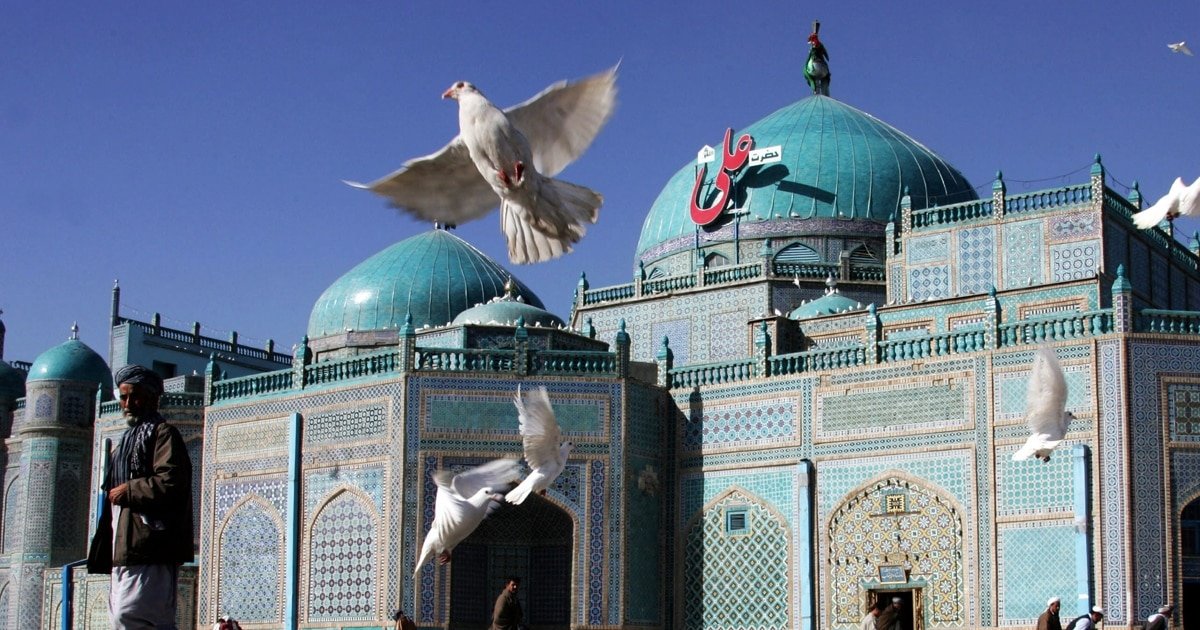
The Shrine of Hazrat Ali, universally known as the Blue Mosque, is the reason Mazar-i-Sharif exists. According to local tradition, the tomb of Ali ibn Abi Talib was discovered here in the 12th century, and a shrine was erected to mark the site. The current structure dates primarily to the 15th century, though it has been restored and expanded many times since.
What makes the Blue Mosque instantly iconic is its exterior: thousands of hand-painted ceramic tiles in vivid shades of cobalt, turquoise, and lapis lazuli cover every surface, creating a shimmering mosaic that seems to change hue with the shifting light. The geometric and floral patterns are mesmerising in their intricacy, and the two towering minarets frame the central dome in a composition that has been photographed by travellers for decades.
The mosque complex sits at the heart of a large public park and plaza. Hundreds of white doves inhabit the grounds, and local legend holds that any grey pigeon among them will turn white within 40 days, touched by the shrine's spiritual energy. Pilgrims and visitors mingle freely in the gardens, and the atmosphere is one of peaceful devotion rather than strict formality.
The interior is equally impressive, with intricate tile work, carved marble, and softly lit prayer halls. Non-Muslim visitors are generally welcome in the outer courtyards, and the shrine's custodians are accustomed to hosting international guests. Photography of the exterior is freely permitted; ask permission before photographing inside the prayer areas.
Twenty kilometres west of Mazar-i-Sharif lie the ruins of Balkh, one of the oldest continuously inhabited cities in the world. The Arabs called it "Umm al-Bilad" — the Mother of Cities. Archaeological evidence suggests settlement here stretching back over 3,500 years, and at various points in history, Balkh was the capital of entire empires.
Balkh was the birthplace (or at least the early home) of Zoroaster, the founder of Zoroastrianism, one of the world's earliest monotheistic religions. It was here that the ancient fire temples burned, and it was from Balkh that Zoroastrian teachings spread across Central Asia and into Persia. Later, Balkh became a major centre of Buddhism, and Chinese pilgrim Xuanzang described dozens of active monasteries when he visited in the 7th century.
The city's golden age as an Islamic cultural centre came under the Samanids and later the Timurids, when it rivalled Samarkand and Bukhara as a seat of learning and art. The great Sufi poet Rumi was born in Balkh in 1207, and the city's intellectual legacy echoes through Persian literature to this day. Genghis Khan's devastation of Balkh in 1220 was so complete that the city never fully recovered, and the centre of gravity shifted to nearby Mazar-i-Sharif.
Today, visitors can walk among the massive earthen walls of the old city, visit the remains of the Haji Piyada mosque (possibly the earliest Islamic building in Afghanistan), and explore the shrine of Khwaja Abu Nasr Parsa with its distinctive ribbed dome covered in blue-green tiles. The ruins are atmospheric and largely unexcavated, giving a raw sense of the layers of civilisation buried beneath the surface.
Mazar-i-Sharif has been a trading hub for centuries, and its bazaars remain some of the most vibrant in Afghanistan. The city's central market area radiates outward from the Blue Mosque, with narrow lanes dedicated to specific trades: spices, fabrics, dried fruits, jewellery, and — most famously — carpets.
Northern Afghanistan is the heartland of Afghan carpet production, and Mazar is the commercial capital of the trade. Turkmen, Uzbek, and Hazara weavers from across the northern provinces bring their rugs here for sale, and the variety is extraordinary. You will find deep crimson Turkmen "elephant foot" carpets alongside delicate silk-and-wool Andkhoy pieces, tribal kilims from Sar-e Pol, and the distinctive blue-and-brown patterns of Balkh province. Many dealers speak some English and are happy to explain the differences in knotting techniques, dyes, and regional styles.
Beyond carpets, the bazaars are worth exploring for their sheer sensory richness. Stalls overflow with almonds, pistachios, and dried mulberries from the northern orchards. Jewellers display lapis lazuli from Badakhshan and turquoise from Herat. Fabric merchants sell hand-embroidered chapan coats — the traditional northern Afghan outer garment — alongside imported textiles from Uzbekistan and Iran. Bargaining is expected, and the merchants are generally welcoming to foreign visitors, often offering tea before any transaction begins.
If there is one time of year to visit Mazar-i-Sharif, it is Nowruz — the Persian New Year, celebrated around March 21. Mazar hosts Afghanistan's largest and most spectacular Nowruz festivities, drawing hundreds of thousands of visitors from across the country and beyond. The celebrations centre on the raising of the Janda, a sacred green flag, at the Shrine of Hazrat Ali, marking the beginning of the new year.
The festival lasts roughly 40 days, and during this period the city transforms. The gardens around the Blue Mosque fill with families, musicians, and street performers. Buzkashi matches — the legendary Afghan horseback sport — are held on the outskirts of the city, with dozens of horsemen competing for honour and prizes. Traditional music fills the air, and food vendors sell everything from bolani (stuffed flatbread) to freshly squeezed pomegranate juice.
For travellers, Nowruz in Mazar offers an unparalleled window into Afghan culture at its most joyful and communal. The atmosphere is electric, the hospitality is overwhelming, and the sight of the Blue Mosque surrounded by celebration is one of the most memorable experiences Afghanistan has to offer. Book early if you plan to visit during Nowruz, as accommodation fills up quickly.
Mazar-i-Sharif is a melting pot of Afghanistan's northern ethnic groups — Tajik, Uzbek, Hazara, Pashtun, and Turkmen communities all call the city home, and this diversity is reflected in its food culture. The cuisine here leans heavily toward Central Asian traditions, with an emphasis on rice dishes, grilled meats, and fresh dairy.
The signature dish of the north is qabuli palau — fragrant long-grain rice slow-cooked with lamb, julienned carrots, and raisins, often served on enormous platters for communal eating. Mazar's version is considered by many Afghans to be the best in the country. Other local specialities include mantu (steamed dumplings filled with spiced meat and topped with yoghurt and lentil sauce), ashak (leek-filled dumplings), and chopan kebab — thick cuts of lamb grilled over charcoal and served with fresh naan bread.
Tea culture is central to daily life. The city's chai khanas (tea houses) serve green tea in delicate porcelain cups, often accompanied by sugar-coated almonds and dried fruits. These tea houses are social institutions — places where business deals are struck, friendships are maintained, and travellers are welcomed with genuine warmth. Do not be surprised if a stranger invites you to share tea; this is standard northern Afghan hospitality, and refusing is more awkward than accepting.
The complete northern Afghanistan experience. Kabul, Bamiyan, Herat, and Mazar-i-Sharif — 10 days across the Silk Road, including 2 full days in Mazar with visits to the Blue Mosque and ancient Balkh.
Is Mazar-i-Sharif safe to visit?
Mazar-i-Sharif is one of Afghanistan's more accessible and relaxed northern cities and is a regular fixture on guided tours. Go Kabul travels here with local guides, private transport, and vetted hotels. Conditions can change across the country, so contact us for the current security picture before you book.
What is there to see in Mazar-i-Sharif?
The city's centrepiece is the Blue Mosque (Shrine of Hazrat Ali), famous for its cobalt tilework and white doves. Nearby are the 3,500-year-old ruins of ancient Balkh, the carpet bazaars, and, in March, Afghanistan's largest Nowruz festival. Most travellers spend two days in and around Mazar.
How do I get to Mazar-i-Sharif?
Mazar-i-Sharif has domestic flights from Kabul, taking about one hour, and sits 55 km from the Uzbekistan border. There is no passenger rail inside Afghanistan. Go Kabul arranges flights or private vehicle transport, guides, and accommodation, and pairs Mazar with the ruins of Balkh, 20 km west.
When is the best time to visit Mazar-i-Sharif?
The best time to visit Mazar-i-Sharif is spring (March to May) and autumn (September to November). Spring is spectacular thanks to green countryside and the huge Nowruz celebrations around 21 March. At 357 metres the climate is milder than the highlands, though summers are hot. Book early for Nowruz.
What is the Blue Mosque?
The Blue Mosque, or Shrine of Hazrat Ali, is a 15th-century shrine believed by many Afghans to hold the tomb of Ali ibn Abi Talib. Its exterior is covered in thousands of cobalt and turquoise tiles, and its plaza is home to flocks of white doves. It is northern Afghanistan's most iconic monument.
Continue planning your northern Afghanistan trip with these related destinations, tours, and travel guides.
Let us build your perfect northern Afghanistan itinerary. Flights, guides, accommodation — all taken care of.
Plan My Trip