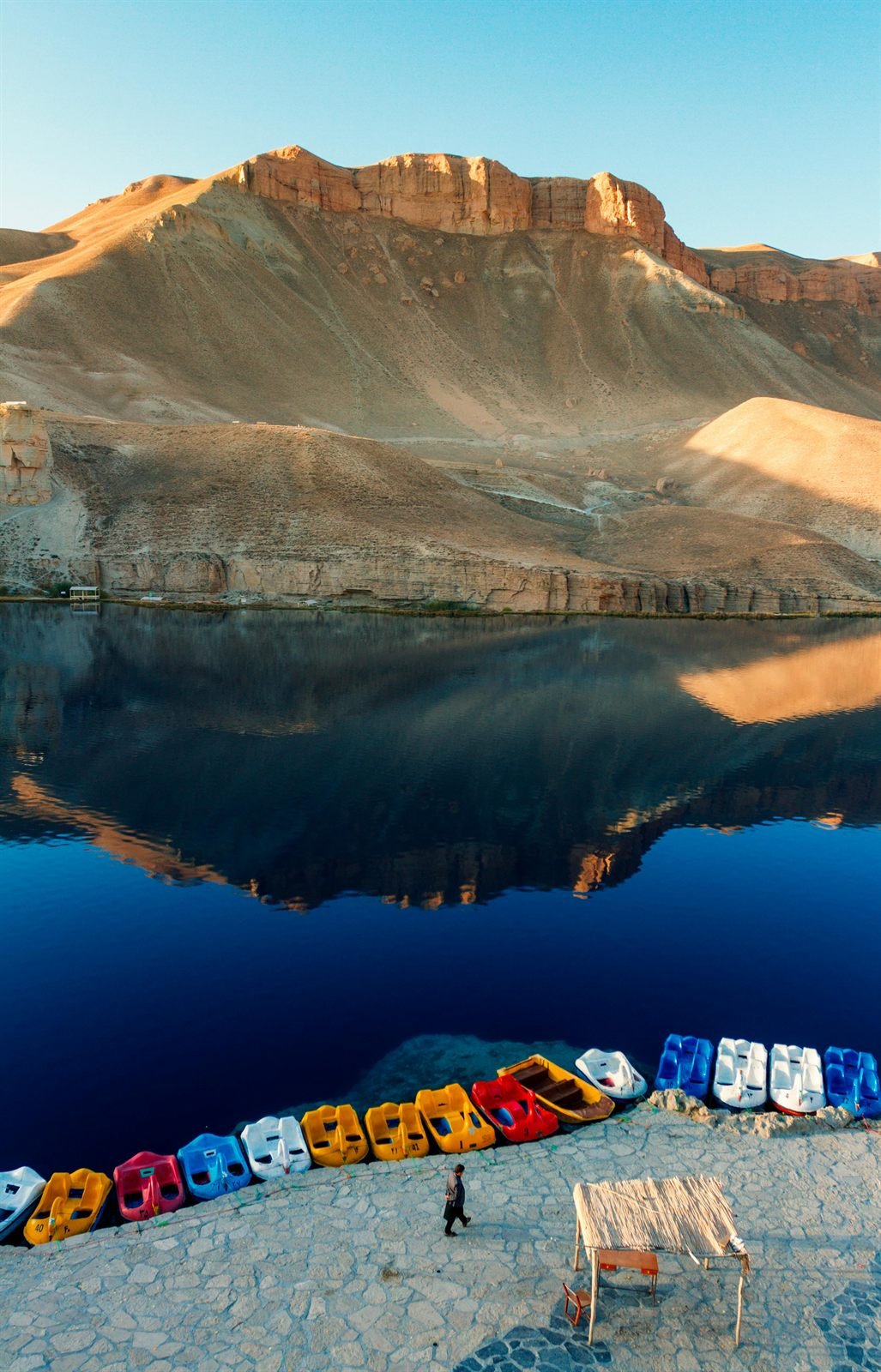
Overview: Afghanistan's First National Park
Band-e-Amir is one of the most extraordinary natural landscapes in all of Central Asia. Located approximately 75 kilometers west of Bamiyan city in the central highlands of Afghanistan, this chain of six brilliant turquoise lakes sits at roughly 3,000 meters above sea level, cradled by towering limestone cliffs and vast stretches of arid desert plateau. The contrast between the vivid blue-green water and the stark, sun-baked rock surrounding it is so dramatic that first-time visitors often describe the scene as surreal, almost impossible.
In 2009, Band-e-Amir was officially designated as Afghanistan's first national park, a milestone moment for conservation in a country long defined by conflict rather than its natural beauty. The designation brought international attention to a site that local communities had treasured for centuries. For generations, the lakes have been considered sacred by many Afghans, with legends attributing their creation to the Prophet Ali, whose name is echoed in several of the lakes' titles.
The national park spans approximately 59,000 hectares of protected land. Despite decades of instability in Afghanistan, the remoteness of Band-e-Amir has helped preserve its pristine character. The lakes remain remarkably clear, fed by underground mineral springs, and the surrounding plateau is home to a diverse range of wildlife adapted to the harsh high-altitude environment. For travelers seeking genuine, untouched nature far from the beaten path, there are very few places on Earth that compare.
The Six Turquoise Lakes
Each of Band-e-Amir's six lakes has its own character, depth, and shade of blue. The word "band" means "dam" in Dari, referring to the natural travertine barriers that separate each lake from the next. Together, these lakes form a cascading chain that stretches across the highland plateau, each one slightly different in size, color, and atmosphere. Here is each of the six lakes, from east to west:
Band-e-Gholaman
The easternmost lake in the chain, Band-e-Gholaman is relatively shallow and broad. Its waters are a lighter shade of turquoise, and its shores are wide and accessible. The name translates roughly to "Dam of the Slaves" or "Dam of the Servants." It is often the first lake visitors encounter when approaching from Bamiyan, and its expansive views across the plateau set the tone for the journey ahead.
Band-e-Qambar
Named after Qambar, a companion of Imam Ali, this lake is deeper and narrower than Gholaman. The surrounding cliffs rise sharply here, creating a more enclosed, canyon-like setting. The water here shifts between deep blue and emerald green depending on the time of day and the angle of the sun. It is quieter and less visited than the larger lakes further west, making it ideal for solitude.
Band-e-Haibat
The largest and deepest of all six lakes, Band-e-Haibat is the centerpiece of the national park. Its name means "Dam of Awe" or "Dam of Grandeur," and it earns that title completely. The water is an intense, almost unreal shade of deep turquoise. Sheer travertine walls rise directly from the water's edge, and the lake is deep enough that its bottom has never been fully mapped. Most visitors spend the majority of their time at Band-e-Haibat, and it is here that local vendors offer pedal boats and simple refreshments during the summer season.
Band-e-Panir
A smaller, more intimate lake, Band-e-Panir translates to "Dam of Cheese," a reference to the white travertine deposits along its shores that resemble blocks of fresh cheese. The mineral formations here are particularly pronounced, creating textured white terraces at the water's edge. It is a fascinating lake for geology enthusiasts and photographers interested in the unique interplay between rock and water.
Band-e-Pudina
"Dam of Mint" takes its name from the wild mint that grows along its banks during summer. This is one of the more secluded lakes, set slightly apart from the main chain. The vegetation here is greener and more lush than the surrounding desert landscape, fed by the moisture from the lake and the natural springs that supply it. The scent of wild herbs in the summer air adds to the sensory experience of visiting this quiet, peaceful spot.
Band-e-Zulfiqar
The westernmost lake, named after Zulfiqar, the legendary double-edged sword of Imam Ali. According to local tradition, Ali struck the ground with his sword and the waters burst forth, creating the lakes. Band-e-Zulfiqar has a distinctive shape and particularly striking cliff formations. The water here tends toward a darker, richer blue. This lake holds deep spiritual significance for many visitors, and it remains a place of quiet reverence and contemplation.
Geology: Natural Travertine Dams
The geology of Band-e-Amir is what makes it genuinely unique among the world's lake systems. The lakes were not formed by glaciers, tectonic shifts, or human construction. Instead, they are the product of a rare geological process involving carbon dioxide-rich water emerging from underground mineral springs. As this water reaches the surface and meets the open air, the carbon dioxide escapes, causing dissolved calcium carbonate to precipitate out and gradually build up into solid travertine barriers, or natural dams.
Over thousands of years, these travertine walls have grown taller and wider, creating the distinct basins that now hold each of the six lakes. The process is ongoing: the dams continue to grow, layer by layer, as mineral-rich water flows over their edges and deposits fresh calcium carbonate. The result is a landscape of sculpted white and cream-colored rock formations, terraced edges, and rippled surfaces that look almost artificial in their precision.
The intense turquoise color of the water comes from the high concentration of dissolved minerals, particularly calcium carbonate and magnesium. These minerals absorb longer wavelengths of light (reds and yellows) and reflect shorter wavelengths (blues and greens), producing the vivid, almost luminous hue that Band-e-Amir is famous for. The color shifts throughout the day, appearing lighter and greener in the morning and deepening to a rich cobalt blue under the midday sun. This interplay of light and mineral chemistry is one of the main reasons the lakes are so photogenic.
Hiking & Activities
Band-e-Amir offers some of the most rewarding hiking in Afghanistan. The terrain ranges from easy lakeside strolls to more challenging ridge walks along the cliff tops that overlook the entire chain of lakes. There are no formally marked trails with signage, but well-worn paths connect the major lakes, and local guides can lead you to viewpoints that most visitors never reach.
The most popular walk is the circuit around Band-e-Haibat, the largest lake. This relatively flat path takes about 45 minutes to an hour and offers constantly shifting perspectives of the water and the cliffs. For a more ambitious day, you can walk the full chain from Band-e-Gholaman to Band-e-Zulfiqar, a route of roughly 10 to 12 kilometers one way that takes most hikers 4 to 6 hours, depending on pace and stops for photography.
Ridge hiking above the lakes is spectacular but requires a good level of fitness and comfort with exposed terrain. The cliff tops provide panoramic views across the entire Band-e-Amir system, with the turquoise water glittering hundreds of meters below against the brown desert backdrop. Sunrise and sunset from these elevated positions are extraordinary.
During summer months, pedal boats are available for rent on Band-e-Haibat, offering a completely different perspective of the lake from the water itself. Swimming is possible but the water is extremely cold even in July and August, rarely exceeding 12 to 15 degrees Celsius. Fishing is practiced by locals in some of the smaller lakes. Horseback riding can also be arranged through local providers for those who want to explore the wider plateau beyond the lake chain.
Wildlife & Ecology
Despite the arid, seemingly inhospitable landscape surrounding the lakes, Band-e-Amir supports a surprisingly diverse ecosystem. The national park is home to several species of birds of prey, including golden eagles, lammergeiers (bearded vultures), and various falcon species that nest in the cliff faces above the lakes. Smaller birds such as choughs, larks, and pipits are common along the lake shores.
On the plateau surrounding the lakes, ibex and urial sheep inhabit the rocky slopes, though they are shy and typically spotted only at dawn or dusk. Afghan foxes, pikas, and various species of rodent also populate the area. Wolves are present in the wider region but rarely seen near the lakes themselves. The streams feeding the lakes contain small populations of native fish, and frogs can be heard in the marshy areas near Band-e-Pudina during summer evenings.
The vegetation around the lakes is sparse but ecologically significant. Hardy grasses, scrub bushes, and wildflowers cling to the rocky soil, providing food for grazing animals. Wild mint, thyme, and other aromatic herbs grow near water sources. The national park designation has helped reduce overgrazing by domestic animals in some areas, allowing native plant communities to slowly recover. Conservation efforts led by the Wildlife Conservation Society and local community groups continue to strengthen protections for this fragile high-altitude ecosystem.
Best Time to Visit
The optimal window for visiting Band-e-Amir runs from May through October, with June being the single best month. In June, winter snowmelt has fully replenished the lakes, bringing water levels to their annual peak and intensifying the turquoise color to its most vivid. Daytime temperatures at 3,000 meters are comfortable, typically between 18 and 25 degrees Celsius, though nights can still drop to around 5 degrees. The surrounding plateau is at its greenest, with wildflowers blooming across the landscape.
July and August are the warmest months, with daytime highs occasionally reaching 28 to 30 degrees. The lakes are popular with Afghan domestic tourists during this period, especially on Fridays. The atmosphere is lively, with families picnicking along the shores and vendors selling snacks and tea. If you prefer solitude, early mornings and weekdays are significantly quieter.
September and early October offer perhaps the most dramatic light for photography, with lower sun angles casting long shadows across the cliffs and deeper, richer colors in the water. The crowds thin out substantially, and the air is crisp and clear, often providing excellent visibility for long-range views. By late October, the first snowfalls begin, and the road from Bamiyan becomes increasingly unreliable. From November through April, the lakes are largely inaccessible due to heavy snow, and water levels drop as the springs slow. The park effectively closes for the winter season.
Photography Tips
Band-e-Amir is one of the most photogenic landscapes in Asia, but the high altitude, intense sunlight, and stark contrasts present specific challenges for photographers. Midday light is extremely harsh and tends to wash out the turquoise color of the water. The best light falls in the first two hours after sunrise and the last two hours before sunset, when the cliffs glow warm amber and the lakes deepen to an almost impossible blue.
Essential Photography Gear and Advice
- A polarizing filter is essential for cutting glare on the water surface and saturating the turquoise tones. This is the single most important piece of gear beyond your camera and lens.
- Bring a wide-angle lens (16-35mm or equivalent) for capturing the full sweep of the lakes and cliffs together. A telephoto (70-200mm) is useful for isolating details in the travertine formations and compressing the layers of cliffs behind the lakes.
- Protect your gear from fine dust. The desert plateau is sandy and wind-blown, especially in the afternoon. Keep a lens cloth and a sealed bag for your camera when not shooting.
- At 3,000 meters, UV haze can affect image clarity. A UV filter helps, and shooting in RAW allows better correction in post-processing.
- Always ask permission before photographing local people, especially women and children. Most Afghans are friendly and willing, but respect is expected and appreciated.
Practical Information
🚗
Distance from Bamiyan
~75 km (2-3 hours by road)
⛰️
Altitude
~3,000 meters / 9,800 feet
🗓️
Season
May - October (June is peak)
🏨
Accommodation
Basic guesthouses & eco-lodges
💰
Entry Fee
Small fee for foreign visitors
📶
Connectivity
Limited mobile signal at lakes
The road from Bamiyan to Band-e-Amir is unpaved and rough for most of its length. A 4x4 vehicle is strongly recommended, and the journey takes between 2 and 3 hours depending on road conditions and recent weather. In spring, sections of the road can be muddy or washed out; in summer, dust is the main challenge. There is no public transport to the lakes. All Go Kabul tours include private 4x4 transport with an experienced local driver.
Accommodation near the lakes is basic but adequate. Several simple guesthouses and eco-lodges have been established in the small settlement near Band-e-Haibat. Expect clean rooms with basic bedding, shared bathrooms, and meals cooked by the host family. There are no luxury hotels. Camping is possible with your own gear, and many travelers prefer to sleep under the stars during the warmer months. Bring a warm sleeping bag regardless of the season, as nighttime temperatures at 3,000 meters can drop significantly even in July.
At 3,000 meters, mild altitude effects are possible for travelers arriving directly from low-elevation cities. Symptoms may include headache, slight breathlessness, and fatigue. Spending a day or two in Bamiyan (2,500m) before heading to the lakes helps with acclimatization. Stay hydrated, avoid strenuous activity on your first day at altitude, and carry basic pain relief. Serious altitude sickness is rare at this elevation for healthy travelers.
Connection to Bamiyan
Band-e-Amir and Bamiyan are almost always visited together. Bamiyan city serves as the gateway and logistical base for trips to the lakes, and the two destinations complement each other perfectly. While Band-e-Amir represents the raw natural beauty of Afghanistan's highlands, Bamiyan offers deep cultural and historical significance: the empty niches of the destroyed Buddha statues, the Shahr-e-Zohak fortress, the Shahr-e-Gholghola citadel, and the vibrant bazaars of Bamiyan town itself.
Most travelers spend 3 to 5 days in the Bamiyan region, splitting their time between cultural sites in and around Bamiyan city and one or two days at Band-e-Amir. This combination provides one of the most complete and rewarding travel experiences available anywhere in Afghanistan, blending ancient history, dramatic landscapes, local hospitality, and genuine adventure.
The journey between Bamiyan and Band-e-Amir is itself part of the experience. The road passes through remote villages where daily life has changed very little over the centuries. You will see farmers working terraced fields by hand, children herding flocks of sheep and goats across open plateau, and the occasional nomadic Kuchi camp with traditional black tents pitched beside the road. Your Go Kabul guide will provide context and facilitate interactions with local communities along the way.
Related Tours
Band-e-Amir features prominently in several of our most popular Afghanistan itineraries. Whether you want a focused Bamiyan experience or a comprehensive cross-country journey, we have a tour that includes these extraordinary lakes.
Kabul & Bamiyan Tour
7 days covering Kabul city, Bamiyan Valley, and Band-e-Amir lakes. Our most popular itinerary.
View Tour →
Custom Private Tour
Design your own itinerary with Band-e-Amir at the center. Choose your dates, pace, and add-ons.
View Tour →
Band-e-Amir FAQ
Is Band-e-Amir safe to visit?
Band-e-Amir is visited as a full-day excursion from Bamiyan, one of the calmer parts of Afghanistan, on guided tours with local drivers and guides. Go Kabul includes the national park on its Bamiyan itineraries with vetted transport and support. Contact us for the current security situation before you travel.
What is there to see at Band-e-Amir?
The park's centrepiece is its six turquoise lakes: Band-e-Haibat (the largest), Band-e-Gholaman, Band-e-Qambar, Band-e-Panir, Band-e-Pudina, and Band-e-Zulfiqar. Visitors hike the canyon rim, photograph the travertine dams, and picnic on the shores. In summer, pedal boats operate on Band-e-Haibat and the water is cold but swimmable.
How do I get to Band-e-Amir?
Band-e-Amir is roughly 75 kilometres west of Bamiyan town, a two-hour drive on an unpaved but well-maintained road. Bamiyan is reached from Kabul by a 45-minute flight or a scenic mountain drive. Go Kabul arranges the full-day excursion, including 4x4 transport, guide, and park logistics.
When is the best time to visit Band-e-Amir?
The best time to visit Band-e-Amir is late May through September, when the mountain road is open and the plateau is green. By October snow can close the passes. Water temperatures stay cold, 12 to 15 degrees Celsius, even in summer, so bring warm layers for early mornings.
Can you swim or camp at Band-e-Amir?
Swimming is possible in summer, though the water is cold, and modest dress is expected. Camping is permitted near the park entrance, and a simple guesthouse offers basic overnight rooms for those wanting a sunrise over the lakes. Go Kabul can arrange either a day trip or an overnight stay.
Ready to See Band-e-Amir?
Join a guided tour to Afghanistan's most stunning natural wonder. Expert guides, safe travel, unforgettable memories.
Plan Your Visit


